.png)


Roland D-10 Linear Arithmetic Synthesiser
The Roland D-10 was the second tranche of Roland D-Series synthesisers to be released in 1988. Three synthesisers were released in this year.
Roland D-20 - Linear Arithmetic Workstation
Roland D-10 - Linear Arithmetic Synthesiser
Roland D110 - Linear Arithmetic rack mount Synthesiser
The Roland D-10 and Roland D-20 were released together in 1988, both were 61 note keyboards. The Roland D-110 followed shortly after as a 19" rackmount synthesiser based on the architecture of the D-10. Production of the D-10 continued from the launch date through to 1991. Finishing a year earlier than the D-20 workstation.
The keyboard had the same key bed as the Roland D-50, a 61-key velocity sensitive key bed. It uses the same Linear Arithmetic (LA) method of synthesis generation as the Roland D-50.
In theory the two synthesisers have the same configurable parameters, but to perform this configuration requires extensive knowledge of multiple sub-menus and not all the parameters from the D-50 are available on the D-10. These include parameters relating to filters and effects. The result of this difference is that the synthesiser file structure of the Roland D-50 and D-10 are different meaning you cannot load files created on one to the other.
The D-10 was a LA based synthesiser released after the D-50. It also included a rhythm generator (same as the Roland D-20).
In my view the D-10 was aimed at the mid-tier professional musician. Either someone that could not afford or didn't need the power of the D-50, but still wanted a keyboard that used LA synthesise and it could take on the road with them.
Many commentators of the time questioned the introduction of the D-10 and you see this coming through to many legacy webpages published currently.
My view. It filled a gap.
It was functionally strong enough that musicians could use it for LA Synthesis. Remember back in the late 1980's and 1990's the D-50's were in demand and carried a premium long after they were discontinued. My one criticism of the synthesiser is the lack of floppy disk drive to load and save patches quickly without the musician having to buy expensive Roland memory cards. My theory on this was that the routines for the disk drive were written to include the sequencer on the D-20 and it would be difficult to maintain two code branches in the limited ROMs of the period.
However, if you were in the hunt for a D-Series synthesiser from this era, I would personally buy the D-20 than the D-10. Purely on the basis of the floppy disk drive and 8-track sequencer.
I acquired my Roland D-10 in the hunt for a D-20. I wanted one of the D-Series synthesisers for the collection and a contact rang me up and said he knew someone selling a D-10 that they had bought and never really used. It was bought by the previous owner as second hand.
I bought this and then aquired the D-20 at a later date and retained both the D-10 and D-20. Both keyboards now need servicing, projects that I have committed to in 2026.
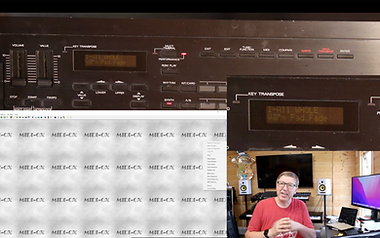
This tutorial walks through two essential processes for keeping a Roland D-10 synthesiser in good working order using System Exclusive (SYSEX) transfer.
The first covers restoring factory sounds to the Roland D-10, explaining that because the instrument lacks a disc drive, patches can only be loaded via a RAM card or SYSEX, with SYSEX being the more accessible route for most owners. It shows how to set up a MIDI interface and MIDI-OX on a Windows 10 machine, initialise the synth correctly, disable write protection, and transmit the official D-series patch file until memory protection re-engages automatically.
The second half demonstrates backing up the synth's internal data, an increasingly useful skill given that RAM cards for these machines have become scarce and expensive. Viewers are guided through the correct cabling, buffer settings and bulk dump mode needed to capture roughly 43,000 bytes of data over about twenty to thirty seconds, along with tips for recognising when the transfer has finished and how to store the resulting file safely for future recall.

This restoration project follows a Roland D-10 that has spent many years sitting in storage, largely untouched and unplayed. The opening stage I give the synthesiser a thorough assessment, checking it over for cosmetic wear such as scratched keys, stray marks and built-up grime, while also noting a number of missing or incorrect screws left behind by a previous owner. Powering the unit up reveals no obvious faults, though an ageing firmware version and a battery overdue for replacement are flagged as early jobs, alongside plans for a deeper clean and a retrobrite treatment to freshen up the yellowed keys.
With the assessment complete, attention turns to opening up the Roland D-10's case itself, since these instruments are accessed from underneath rather than through a lift-up lid. The video walks through removing the retaining screws, supporting the keyboard safely on foam blocks, and dealing with early signs of rust on the metal frame. Once inside, I give viewers a tour of the power supply, main circuit board and user interface, setting the scene for the practical restoration work still to come as this classic keyboard is gradually brought back to full health.
Click anywhere on the image or title to see the work undertaken on this synthesiser.