.png)


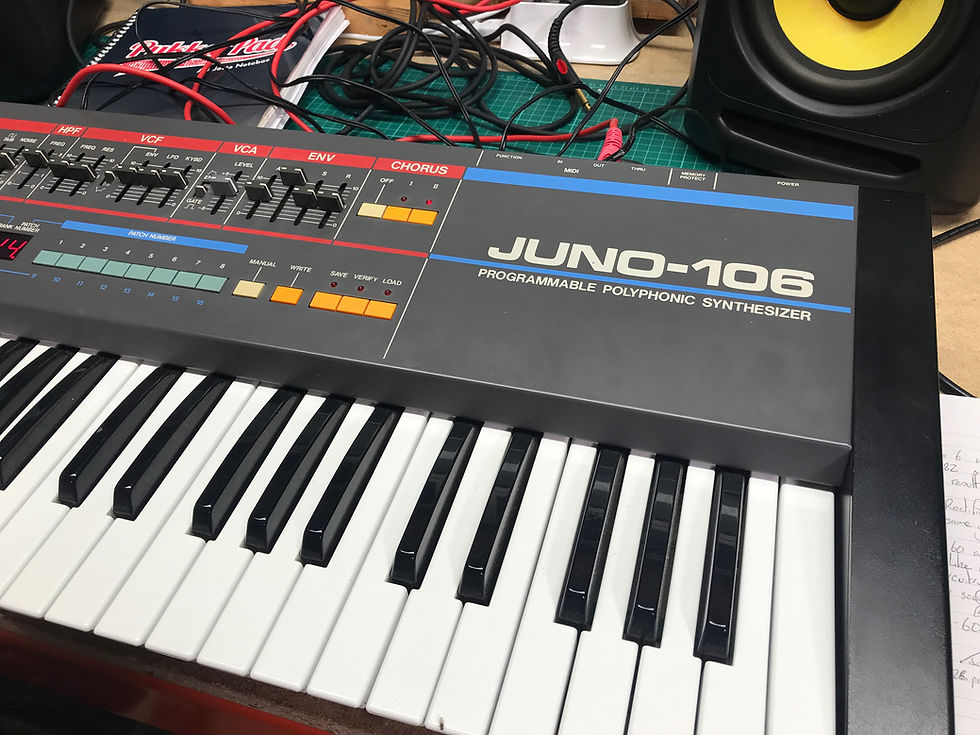
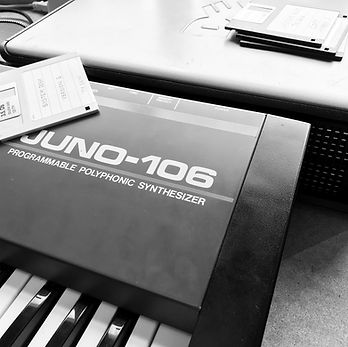
Roland Juno-106 6 Voice Analogue Synthesiser
The Roland Juno-106 is the last of the classic Juno synthesisers released by Roland in 1984. I said elsewhere that this synthesiser was the last of the classic Juno synthesisers with the Roland Juno-6 and Roland Juno-60 preceding it. Both the preceding synthesisers were released in 1982.
Like the Roland JX range of synthesisers, the Roland Juno range implemented an architecture that was centered around a Digitally Controlled Oscillator or DCO. The sound that was heard was generated using analogue circuitry. But the parameters that the synthesiser used to create the sound was generated and controlled by digital circuitary within the synthesiser.
The key difference between the JX and Juno was the number of oscillators deployed for the sound generation. The JX range used two DCO's whereas the Juno range used just a single DCO, which on the Juno Roland then augmented with a chorus effect. This chorus modulated the sound that came from the single oscillator making the sound thicker. This sound became incorporated into the pop music of the mid to late 1980's and early 1990's as the Roland Juno-106 was integrated the into studios and touring rigs of many of the bands of the era.
If you want to own a classic Roland Juno synthesiser then the jury is out on which model to get.
Personally I would not try to buy a Juno-6 unless you were happy to dial in your patches each time you played it.
Having played a Juno-60 and Juno-106, in my opinion there is a slight tonal difference between the two.
While there are no firm statistics on the exact number instruments sold in each configuration, it is safe to say that more Juno-106's were manufactured than either the Juno-6 or Juno-60. Sourcing parts for these synthesisers is difficult for all models, but for the earlier models it will be harder as there are less instrument deemed beyond economical repair than the later Juno-106 meaning dwindling parts pool.
However, I would also state that the Roland JU-06 and Roland JU-06A are very good representations of the Roland Juno-60 and Roland Juno-106. Once in the mix I would question whether anyone would know you had used newer hardware.
Oh of course you could use the Roland cloud version also!


What connections are available on the back of the Roland Juno-106?
Normally in the goldfish bowl the camera looks over the back of the keyboard and at me to provide the explanation of what each socket, switch and button does. This time the explanation is in the workshop.
Change of location, but the same explanation.
Click anywhere on the image or title to see the work undertaken on this synthesiser.