.png)


Yamaha CX5M
Yamaha MSX The Music Computer
The MSX computer range was the Japanese answer to the 8-bit American Commodore 64 or British Sinclair Spectrum (although this was also sold under the Timex brand in the United States). In many ways it was more functional as it had lots of expansion possibilities. (Or maybe I should have said it was the Japanese answer to the British BBC Model B which was used by many of us in the United Kingdom of a certain age in our schools!)
The MSX standard was created and agreed by many Japanese (and far east) manufacturers during the early 1980's. The computers produced were based on a common hardware specification and ran an early version of Microsoft Basic (version 2.0) loaded from an onboard ROM at boot. This allowed for interchangeable hardware e.g. cartridge-based software and peripherals as well as software (mainly games like the two other computers mentioned above).
Yamaha released several versions of their interpretation of the MSX computer. One of these versions was the Yamaha CX5M (which came as a basic version (CX5M), a second-generation version (CX5M II) and the last version (CX5M II/128).
The Yamaha CX5M was special. It was the music computer and was supplied with a 4 operator FM synthesiser, audio outputs, plug in music keyboard and MIDI IN and OUT.
The synthesiser module plugged into the underside of the computer and was comparable to the DX21 Keyboard / FB-01 module synthesisers that were released by Yamaha as separate units.
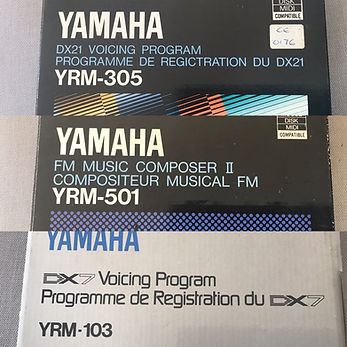
Yamaha supported the release of this computer with a range of cartridge-based software utilities which can normally be identified by the designation YRM before a 3 digit number e.g. YRM 103. These cartridges supported sequencing, software-based music generation and editing programs for the synthesisers of the time (DX7, FB-01 etc).
A number of third-party software houses also produced music cartridges for the computer that either used the on board synthesiser, were music programs in their own right or provided other music utilities. I should point out that all these cartridges will work on other MSX computers, but functions where the synthesiser module are called will not work on these unless you have separately purchased the SFG-05 synthesiser module.
The Yamaha CX5M would also allow software to be loaded into the computer from a cassette tape (common for the time) and a 3.5" 720Kb floppy disk which was introduced as an additional peripheral later in the production run. Generally, all cassette software will load and run on this computer when it is used purely as a computer and not for making music.
Although I must admit I do play games on my Yamaha CX5M I acquired it principle to run music related software.
The sequencing software allowed you to create sequences on the CX5M and then use the MIDI interface to send MIDI channels out to other MIDI connected instruments. Even if you were not using MIDI to drive another instrument the clock connection ensured all instruments remained in sync while playing.
I bought the Yamaha CX5M first but really wanted the later CX5M II/128 which I was lucky enough to acquire several years later. Depending on the model you will either need an old TV with an analogue tuner to use this computer or a monitor that accepts RGB input. The RGB option was only available on the later models. If you can, I would buy one of these models. The RGB models are easily identified from the socket on the back of the computer. You can modify the earlier models to remove the Radio Frequency (RF) and convert these to a composite or even HDMI output.
There is another Yamaha music computer, this was also an MSX computer and called the Yamaha CX7M and based on the MSX2 standard. I have only every seen this computer on internet pages. And never seen it on any sales portal. The key difference between the CX5M and CX7M is the inclusion of the YRM-502 cartridge in the computer.